Chart to play with
Best time to see the waterfalls in Da Lat: month by month
Three waterfalls from Da Lat
★ 4.9 · 1,529 opinions
Twelve months of waterfalls
Seasons at the Da Lat falls, month by month
Choose a month to see the daylight and what the official pages say about the water.
Sunset
Jan
- Sunset is around 17:40
Dry, cool and sunny, inside the national tourism authority's best-time window.1
Feb
- Sunset is around 17:53
Still inside the dry window that runs from December to March, so the steps are at their driest.1
Mar
- Sunset is around 17:57
The last month of the best-time window, and a dry month on the weather page too.1,9
Apr
- Sunset is around 17:58
The weather page counts the rains from April, while the Da Lat page starts them in May.3,2
May
- Sunset is around 18:02
A transition: the Da Lat page starts the rain here, and the weather page still lists dry weather until May.2,9
Jun
- Sunset is around 18:11
Rainy on both pages, with summer afternoon showers that fill the falls.3,13
Oct
- Sunset is around 17:28
The last rainy month on both weather pages, with Pongour still at its peak.3,4
Nov
- Sunset is around 17:19
Pongour's dramatic stretch ends here, while the weather page lists the month as dry.4,9
Sunset is worked out for the 15th of each month on Vietnam's clock (UTC+7). Season notes come from the national tourism authority's pages, not from a station: none sits near Da Lat at 1,500 m.
When the waterfalls in Da Lat run strongest, when the steps are driest, how the day itself changes between a misty morning and a chilly evening and when holidays slow the tours.
Editorial team, dalatwaterfalls.top · Updated November 16, 2026 · A 9 min read
In brief
- The dry windowDecember to March is dry, cool and sunny, according to the national tourism authority.1
- The rainsThe same authority gives rain from May to October on one page and April until October on another.2,3
- The strongest waterPongour peaks between July and November, in the rainy season.4
- The altitudeDa Lat sits at 1,500 m, with spring-like weather all year and chilly nights.2
- The packA light jacket and an umbrella.5
Dry months or wet months: the real trade-off
There is no wrong month for the waterfalls of Da Lat, only a choice between good things. The dry months give you clear skies and safe footing, and the wet months give you the most water. The national tourism authority calls December to March the best stretch for the city, dry, cool and sunny.1 For the falls it adds that the monsoon swells the rivers of the highlands and makes the local waterfalls thunderous.6
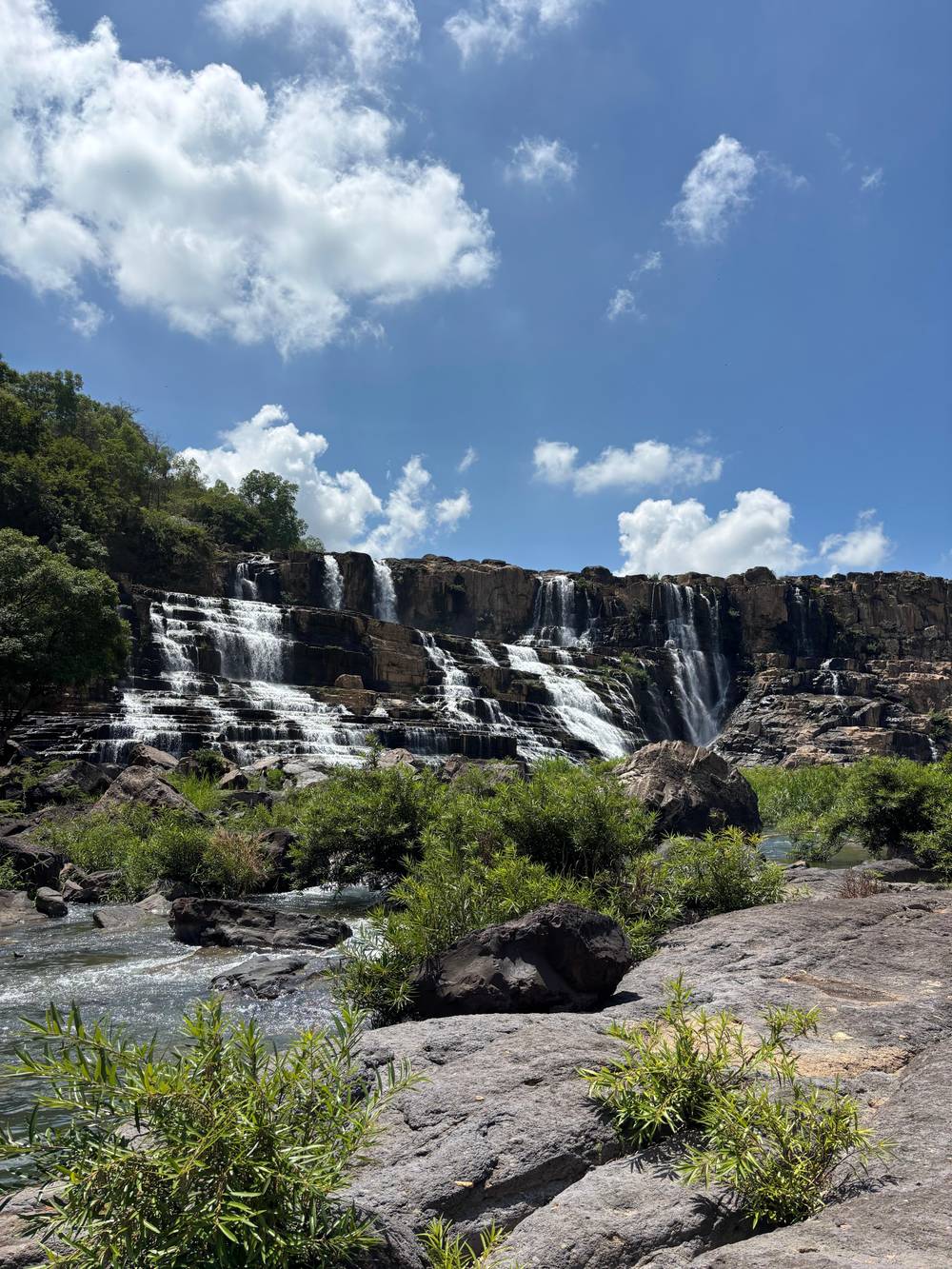
What that means in practice depends on the fall. Pongour, the wide staircase, is described as at its fiercest from July to November, with powerful torrents, and gentler in the dry season, when its water runs peaceful and clear.4,7 Datanla is different: its coaster and zipline are the draw, and the authority speaks of rides past cascading waters, so the season matters mostly for the footing on the walk.8 Read the choice as one of mood, not of success or failure.
If you can choose freely, November is the month where the pages overlap: the Pongour feature still counts it in its dramatic stretch, while the weather page counts it in the cool, dry half of the year.4,9 Take a light raincoat anyway. If your dates are fixed, do not postpone the trip for the sake of a fall: the authority says Pongour welcomes visitors in every month, and the rest of the circuit offers something in every month.7
Four pages
Season dates by official page
| Page | Dates | What it says |
|---|---|---|
| Da Lat destination page | Dec - Mar; May to October1,2 | Best time dry, cool, sunny; rain May to October |
| Weather page | April until October; November - May3,9 | Rainy season, then cool to cold and dry |
| Pongour feature | July to November4 | The most dramatic water |
| Highland feature | Summer13 | Afternoon showers fill the waterfalls |
The pages describe the same highlands in different terms, so use the overlap and ask your operator about the week.2
What the national tourism pages say, and where they differ
The pages that matter are not in complete agreement, and the honest approach is to show them side by side. The authority's Da Lat page recommends December to March and gives rain from May to October.1,2 Its weather page sets the rainy season from April until October, with November to May described as cool to cold, dry and clear.3,9 The Pongour feature gives July to November for the strongest water.4
These ranges overlap rather than contradict one another, and each describes a different thing: the city's rain, the city's dry spell or the peak of one fall. When pages disagree by a month, treat April, May and November as uncertain and plan for either kind of weather. Our recommendation is to book the day you want and keep the cancellation window open until the evening before, because the forecast will tell you more than any page.
Temperatures are the second point of disagreement. One authority page says the highland climate stays cool all year, averaging 15°C to 24°C, with summer showers that fill the waterfalls.13 Another says temperatures hover around 20 degrees Celsius year-round.14 A third page prints a January low of 20 and a July high of 30.15 That is a lowland-style range that does not fit a highland town, so we do not rely on it. We use the range of 15°C to 24°C as the planning figure for the city and mention the others so you can see the spread.
A day with every season in it
The authority has a lovely line for Da Lat: a single day can feel like four seasons.17 The morning comes in soft, with mist and crisp air that recall spring.10 That is the best light for the first fall of a tour, with mist rising from the water and a jacket still welcome. That makes any single temperature a half-truth, and it is why the national pages disagree so easily on numbers.
Around midday the city turns as warm as a summer day, and the authority points the afternoon at waterfalls.11 That is the moment for the long drive and the big views, when the sun is highest and the sky clearest. Then comes evening, calm and chilly, when temperatures drop.12 Plan your layers for the day, not just the month, and keep a light jacket in the van for the ride back. Between those moods sits the middle of the day, which most visitors spend in the van or at the falls.
The practical result is an argument for the early start. A small-group day whose hotel pickups run between 8:00 and 8:30 AM reaches its first stop in the morning cool and the later stops in the warmer afternoon. If you ride yourself, set off after the mist has lifted and be back before the evening chill. That is also the way to read a tour's 8-hour length: the day is long enough to meet every mood.
Pick your months
Which month suits you?
Pick what you value most and see the matching window.
If I want the strongest water
July to November
The authority calls this Pongour's most dramatic stretch.4
If I want dry steps and clear skies
December to March
The authority calls these months dry, cool and sunny.1
If I want fewer crowds
A weekday outside holidays
Weekends are very popular at Elephant Falls.16
If I am traveling around Tet
Book early and expect changes
Our day moves the start to its office in the holiday traffic.
If I want a calm, clear fall
The dry season
The authority says the streams flow gently and clear in the dry season.7
Storms, closures and slippery steps
Rain on a waterfall day is more than a nuisance. A listing for a classic Da Lat waterfall tour asks guests in the rainy season for sandals or slippers, a thin raincoat and a waterproof pouch for the phone, and one of its notes logs a storm closure of Pongour from 20 November 2025 until 24 November. That is a snapshot of how the season can change a day plan. Treat the note as a reminder to check, not a forecast.
Other listings echo the caution. Our coffee-and-silk day warns that access to Elephant Waterfall can be limited when safety conditions require it, and our small-group day calls the fall closed for now but visible from the pagoda side. These notes are not about a month; they are about conditions that can change on any day of the year, and more often in the wet months. Flexibility is the useful attitude on such days.
The simple rule is to ask. On the evening before your tour, message the operator and ask which falls are open, whether the steps are wet and whether the schedule has changed. A booking with a full refund until the day before gives you a window to decide with fresh information. Wear shoes with grip in every season, because mist wets the stone even when the sky is clear. Ask early rather than late, because operators answer better before the van is loaded.
Price your day
Compare days that visit the falls
Enter how many are traveling and see what each way of visiting the falls costs at its starting fare.
Compare 4 alternatives
Compare days that visit the falls
Enter how many are traveling and see what each way of visiting the falls costs at its starting fare.
- Small-group dayThree falls · starting at, per person $20
≈
View - Classic waterfall dayShort stops · starting at, per person $20
≈
View - Countryside dayPongour focus · starting at, per person $20
≈
View - Coffee and silk daySeven attractions · starting at, per person $23
≈
View
Figures are GetYourGuide from-prices, translated at the ECB reference rate. The booking step shows what you pay exactly.
One day, many moods
How a Da Lat waterfall day feels
Morning
Mist and crisp air
Morning arrives wrapped in mist and crisp air, reminiscent of spring.10
Midday
The warmth of summer
By midday the city takes on the warmth of summer.11
Afternoon
Waterfall hours
The afternoon suits exploring waterfalls.11
Evening
Calm and chilly
Evening is calm and chilly, with temperatures dropping.12
Pack
Layers
The authority advises a light jacket and an umbrella.5
Holidays, weekends and the festival
Tet and the national holidays change the tours as well. Our small-group day says that around the national holiday and Tet it asks guests to come to its office for the start, because the traffic prevents it from collecting everyone at their hotels. If you travel in those weeks, book early, expect slower roads and keep a spare day on each side of any flight. If you are unsure of the dates, ask your operator which days they treat as holiday days.
Weekends matter at the busy falls. A Vietnam News Agency feature says the Elephant Waterfalls site is very popular during weekends.16 A weekday morning is the quiet option, and an early start on a weekend is the compromise. If you must go on a weekend, book the earliest start the operator offers. A weekday visit also leaves more room on the viewing platform, whatever the season. Even a short weekend morning is quieter than the afternoon.
Pongour has its own date in the calendar. The authority dates the festival to the 15th day of the lunar year's first month, which is the day of the Lantern Festival.18 Expect a livelier site that day and plan to arrive early or choose another day. The lunar date moves in the Gregorian calendar each year, so check it before you fix your dates. A visitor who wants a calm photograph should avoid the festival day.
Video
The best time to visit Da Lat
Gadt Travel on YouTube · Your tap on play is what loads the video.
Morning in Da Lat arrives softly, wrapped in mist and crisp air reminiscent of spring.
Before you go
A checklist by season
Every season3
In the rains3
- Pack a light raincoat and a pouch that keeps the phone dry
- Ask about closures the evening before
- Expect the strongest flow at Pongour4
What to pack in each season
The authority's advice for Da Lat is short and sound: pack a light jacket and an umbrella.5 In the dry months the jacket does most of the work, because nights are chilly, as the Da Lat page puts it.2 In the wet months the umbrella gives way to a light poncho, which is easier on a trail and does not catch on branches. Keep both in a day bag so that you do not have to go back to the hotel.
For a waterfall day, footwear matters more than clothing. Sandals with a firm grip or trainers you can soak are the right choice on wet rock in any season, and spare socks left in the van are a small comfort that pays back after the first fall. Put the phone in a dry pouch and the cash in a small bag. Spare socks and a small towel are cheap insurance. Dry socks in a bag are worth the space they take.
If you plan to canyon, the packing list changes: the canyoning listing lends wetsuits and canyoning shoes, and a combination listing asks you to bring dry clothes and a towel. The season affects how cold the water feels, and the cool highland air makes a warm layer for the ride back a good idea in every month. If your plans change, a booking through that listing is refundable until the day before.
Picking your month for the big falls
Tie the month to the fall you most want to see. For the strongest water at Pongour, aim for July to November, and expect a livelier, wetter day.4 For the clearest weather and the safest steps at Elephant Falls and Datanla, aim for the dry, cool and sunny months of December to March.1 For a visit that suits every fall, the overlap of the pages in November is the most defensible compromise.
If you only have a few days for tours in Da Lat, do not rearrange the whole trip for a fall. The authority notes that Pongour welcomes visitors in every month, and each season gives it a different character.7 The other falls on the circuit share that flexibility, and a day tour that visits them in a loop will not collapse because it rains in the afternoon. Plan around the days that matter to you, such as a birthday or a flight, and let the weather decide the order of the stops.
Whatever you choose, remember what matters most: ask the operator about access on the day, and dress for four seasons in a day. The rest is a matter of taste. A grey, misty morning at a loud, full fall is as good a waterfall day as a bright, dry one, as long as you have the right shoes and a jacket in the van. Ask the operator, wear grip shoes and let the day be a little wild. Take that advice into account and your choice is hard to get wrong.
FAQ
Quick answers to quick questions.
What is the best month for Da Lat waterfalls?
When is the rainy season in Da Lat?
How cold is Da Lat?
What should I wear on a waterfall day?
The authority advises a light jacket and an umbrella, and listings advise sandals or slippers and a raincoat.5
Can waterfalls close in the rainy season?
A listing noted a Pongour closure for a storm until 24 November 2025.
Does Tet affect the tours?
Our small-group day moves the start to its office around the national holiday and Tet because of the traffic.
Is the day itself changeable?
The authority describes four seasons in a single day.17
Sources
- Viet Nam National Authority of Tourism (vietnam.travel) · Da Lat ↩
- Viet Nam National Authority of Tourism (vietnam.travel) · Da Lat ↩
- Viet Nam National Authority of Tourism (vietnam.travel) · Weather and climate in Vietnam ↩
- Viet Nam National Authority of Tourism (vietnamtourism.vn, Wayback copy) · Pongour Waterfall: A majestic gem in Central Highlands ↩
- Viet Nam National Authority of Tourism (vietnam.travel) · Highland Escape: Coffee, Waterfalls & Cool Breezes in Da Lat ↩
- Viet Nam National Authority of Tourism (vietnam.travel) · Highland Escape: Coffee, Waterfalls & Cool Breezes in Da Lat ↩
- Viet Nam National Authority of Tourism (vietnamtourism.vn, Wayback copy) · Pongour Waterfall: A majestic gem in Central Highlands ↩
- Viet Nam National Authority of Tourism (vietnam.travel) · Highland Escape: Coffee, Waterfalls & Cool Breezes in Da Lat ↩
- Viet Nam National Authority of Tourism (vietnam.travel) · Weather and climate in Vietnam ↩
- Viet Nam National Authority of Tourism (vietnam.travel) · Da Lat: Enjoy Four Seasons in a Day ↩
- Viet Nam National Authority of Tourism (vietnam.travel) · Da Lat: Enjoy Four Seasons in a Day ↩
- Viet Nam National Authority of Tourism (vietnam.travel) · Da Lat: Enjoy Four Seasons in a Day ↩
- Viet Nam National Authority of Tourism (vietnam.travel) · Highland Escape: Coffee, Waterfalls & Cool Breezes in Da Lat ↩
- Viet Nam National Authority of Tourism (vietnam.travel) · Farm Tours, Flowers, Strawberries and Coffee: Agrotourism in Da Lat ↩
- Viet Nam National Authority of Tourism (vietnam.travel) · Weather and climate in Vietnam ↩
- Viet Nam News (Vietnam News Agency) · The hidden cave and waterfall near Da Lat ↩
- Viet Nam National Authority of Tourism (vietnam.travel) · Da Lat: Enjoy Four Seasons in a Day ↩
- Viet Nam National Authority of Tourism (vietnamtourism.vn, Wayback copy) · Pongour Waterfall: A majestic gem in Central Highlands ↩